|
|
Q: But I heard that char a[] was identical to char *a.
A: Not at all. (What you heard has to do with formal parameters to functions; see question 6.4.) Arrays are not pointers, though they are
closely related (see question 6.3) and can be used similarly (see questions 4.1, 6.8, 6.10, and 6.14).
The array declaration char a[6] requests that space for six characters be set aside, to be known by the name ``a''. That is, there is a location named ``a'' at which six characters can sit. The pointer declaration char *p, on the other hand, requests a place which holds a pointer, to be known by the name ``p''. This pointer can point almost anywhere: to any char, or to any contiguous array of chars, or nowhere [footnote] (see also questions 5.1 and 1.30).
As usual, a picture is worth a thousand words. The declarations
char a[] = "hello";
char *p = "world";
would initialize data structures which could be represented like this:
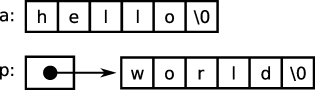
It is useful to realize that a reference like x[3] generates different code depending on whether x is an array or a pointer. Given the declarations above, when the compiler sees the expression a[3], it emits code to start at the location ``a'', move three past it, and fetch the character there. When it sees the expression p[3], it emits code to start at the location ``p'', fetch the pointer value there, add three to the pointer, and finally fetch the character pointed to. In other words, a[3] is three places past (the start of) the object named a, while p[3] is three places past the object pointed to by p.
In the example above, both a[3] and p[3] happen to be the character 'l', but the compiler gets there differently. (The essential difference is that the values of an array like a and a pointer like p are computed differently whenever they appear in expressions, whether or not they are being subscripted, as explained further in question 6.3.) See also question 1.32. |
|






 发表于 2013-7-8 16:58:26